
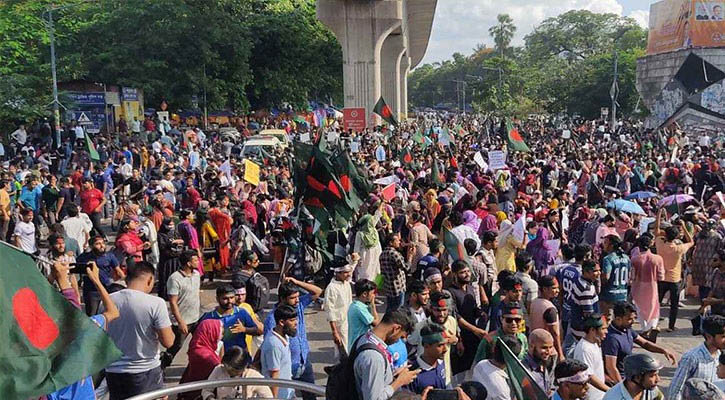
In a recent clarification, Mahfuz Abdullah, the coordinator of the Anti-Discrimination Student Movement’s liaison committee, stated that there have been no discussions about forming a new political party. This statement came in response to widespread media reports suggesting that the student activists were considering establishing a political entity outside the main two political parties in Bangladesh.
The misinformation seems to have originated from an interview with Reuters, which Abdullah claims was misinterpreted by various local media outlets. To address the confusion, he took to Facebook on Friday, August 16, to set the record straight.
According to Abdullah, his words were incorrectly reported. “The report by Reuters conveyed my statement in a wrong light, and the erroneous or purposefully misleading translations by the Bangladeshi media exacerbated the situation,” he explained. He emphasized that the primary focus of their current efforts is not on political organization but on dismantling the authoritarian regime and discussing the structure of a new political setup that ensures accountability to the people.
During the interview, he mentioned that the Reuters journalist repeatedly inquired whether the movement would evolve into a political party to overcome the bipartisan structure currently dominating Bangladeshi politics. Abdullah responded by underscoring their commitment to systemic reform rather than immediate political party formation. “Our current aim is to hold the government accountable and to ensure that any party in power adheres to democratic principles and the will of the people,” he noted.
Abdullah also pointed out a specific error in Reuters’ report, stating that the word ‘voters’ was mistakenly used instead of ‘citizens,’ which skewed the context of his statements about electoral politics. He clarified, “Our conversation barely touched upon electoral politics. It was more about creating a framework where any political party would be inherently accountable to its citizens.”
The coordinator reiterated that their goal is to channel the political struggle towards constructive outcomes and systemic change. “When the time is right, the nature of our political organization or structure will become clear to everyone,” Abdullah added.
This clarification comes at a crucial time as Bangladesh grapples with political instability and the aftermath of a mass uprising that has led to significant shifts in the political landscape. The student movement continues to emphasize that their fight is against the system itself and not about creating a space for traditional political maneuvering.